

FOOD SERVICE
Our food safety efforts focus on ensuring that food offered to consumers is safe, unadulterated, and accurately represented. The Environmental Health Division establishes rules and definitions and sets standards for food operations, including requirements for management, staff, equipment, and facilities. We also support food establishments through plan review, permit issuance, inspections, employee restrictions when necessary, and permit suspension to protect public health.
To report a suspected foodborne illness, complete the Utah Department of Health reporting form.
FOOD SAFETY TRAINING & PERMITS
Select a topic below to view details.
Food Handler | Training
All food handlers must obtain a permit from the local health department before handling food served to the public. This requirement is established under the Utah Administrative Code: R392-103 Food Handler Training & Certificate Rule.
To receive a permit, an applicant must:
- Complete a course from an approved food handler training provider
- Pass the required exam
- Receive a certificate of completion
The health department cannot issue a food handler permit without documentation of this certificate.
Important: Training providers submit certificate documentation directly to the health department. Once received, a food handler card is mailed to the address provided during registration.
IN-PERSON CLASS ($25)
Available at our Washington County office:
620 S 400 E #334, St. George, UT
English Classes
- 1st and 3rd Monday of each month
- Time: 3:30 p.m.
Spanish Classes
- 3rd Wednesday of the following months: February, April, June, August, October, December
(October 21st has been canceled.) - Time: 3:00 p.m.
ONLINE COURSE
Cost varies depending on the provider. Only certificates from courses listed on the approved providers list will be accepted by the health department to obtain a food handler permit.
Food Manager | Certificate
To become a Certified Food Safety Manager in Utah, individuals must pass an approved, accredited food safety manager examination. This requirement is established under the Utah Administrative Code: R392-101 Food Safety Manager Certification Rule.
REGISTRATION REQUIREMENTS
Individuals who pass an approved certification exam must submit proof of a passing score to their local health officer
within 60 days of receiving their documentation.
Approved exams must meet state requirements outlined by the Utah Department of Health and Human Services, including nationally recognized certification standards such as ANSI accreditation.
Approved NATIONAL examination list: Food Safety Manager Certification.
SUBMISSION OPTIONS
Documentation must be submitted to the Southwest Utah Public Health Department. Include the name of the food establishment where you will be employed.
Mail (or in-person delivery)
Southwest Utah Public Health Department
Attn: Environmental Health Division
620 South 400 East
St. George, UT 84770
Through Your Health Inspector
You may also speak with your designated health inspector and submit your documentation directly through them.
Food Establishment | Permit
Before applying for a permit, food service establishments (new, remodeled, or changing operations) must meet all requirements on the Food Service Establishment Checklist.
Plan review time: 30 business days
Forms & Resources
Mobile Food | Permit
Before applying for a permit, mobile food operations must meet all requirements on the Mobile Food Service Checklist.
Plan review time: 30 business days
Forms & Resources
Events | (Temporary) Permit
Prior to an event, a temporary food service operation must obtain a permit before operating. Food must be handled, prepared, and served safely to prevent foodborne illness. The Southwest Utah Public Health Department reserves the right to prohibit or discontinue any food operation that poses a risk to public health or safety.
A Temporary Food Service Permit must be prominently displayed during operation.
General Guidelines
- Permit must be displayed in a visible public location
- Disposable utensils must be provided in sufficient quantity when used
- Dust and windblown debris must be controlled
- Liquid waste (including handwashing waste) must be collected and legally disposed of — not to storm drains
- Food waste, grease, and wash water must be properly contained and disposed of
- Additional requirements may be imposed by the Environmental Health Officer
Food Safety Guidelines
- All food must come from approved, inspected sources
- Raw seafood or shellstock may not be served
- Water hoses must be NSF-approved if used
- Cold foods must be held at 41°F or below
- Hot foods must be held at 135°F or above
- Potentially hazardous foods must be properly controlled at all times
- Food must be protected from dust, insects, and contamination during storage, preparation, and service
- Food may not be stored directly on the ground
- Food must be covered or protected at all times when not actively served
Personnel Guidelines
- All food workers must have a valid food handler permit
- Clean clothing and effective hair restraints are required
- Tobacco use or eating is prohibited in food preparation and service areas
- Individuals with illness symptoms such as vomiting, diarrhea, fever, or infected wounds may not handle food
Booth Requirements
- Booths must have a floor and ceiling
- Floors must be smooth, durable, and cleanable (no dirt, grass, or sawdust)
- Ceilings must be constructed of suitable, cleanable materials
- Cooking equipment must be properly protected and kept clean
- All utensils and equipment must be protected from dirt and insects
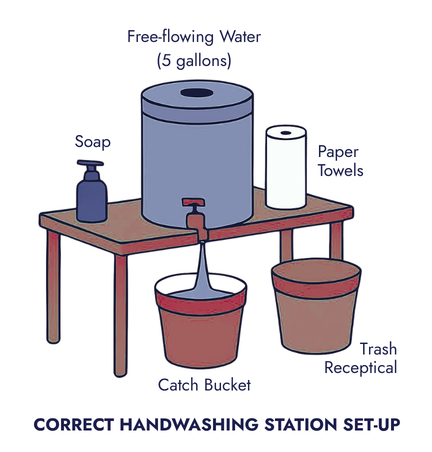
Handwashing
- A handwashing station must be provided within the booth
- Must include at least 5 gallons of water with a free-flowing valve
- Soap and paper towels must be provided
- Wastewater must be collected in a separate container
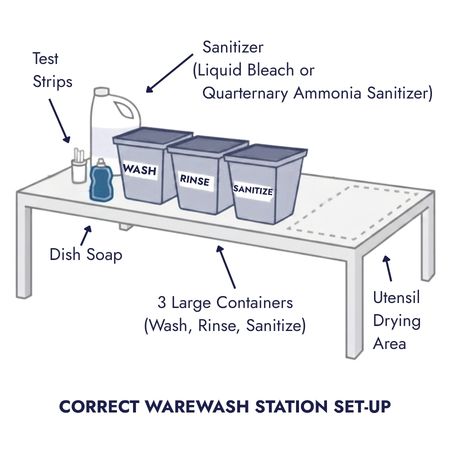
Warewashing
- A three-compartment warewashing station must be set up within the booth
- Must include wash, rinse, and sanitize containers large enough to immerse the largest utensil fully
- Dish soap and an approved sanitizer must be provided
- Test strips must be available to verify proper sanitizer concentration
- Wash, rinse, and sanitize reusable utensils or equipment every 4 hours
- Bring extra clean utensils or dishware and switch them out every 4 hours
- Allow utensils and equipment to air dry in a designated drying area
Food Handling Best Practices
- Keep menu simple to reduce risk
- Purchase food from approved commercial sources only
- Cook, cool, and reheat food rapidly and safely
- Keep hot foods above 135°F and cold foods below 41°F
- Use utensils instead of hands for food handling
- No barehand contact with ready-to-eat food
- Keep all food covered when not in use
- Clean and sanitize equipment frequently
Forms & Resources
FOOD SAFETY FEES
FOOD SAFETY FEE PAYMENT
RESTAURANT PET POLICY
RESTAURANT PET POLICY
Contact Us
(435) 986-2580
Food Trucks in Washington County:
(435) 986-2584
Food Trucks in Iron, Beaver, and Garfield County:
(435) 865-5154
Food Trucks in Kane County:
(435) 296-5477